The results of the 4P-CAN Project were showcased at the European Public Health Conference Conference, held in Bilbao, Spain, from 11 to 13 November 2026.
Two scientific posters, led by researchers from the Universidade de Aveiro and Instituto Nacional de Saúde Doutor Ricardo Jorge, in collaboration with researchers from IARC – International Agency for Research on Cancer / World Health Organization and Asociația Eurocomunicare, were presented at the conference.
These studies are part of Work Package 4 (WP4), which seeks to understand how different population groups perceive, engage with, and respond to cancer prevention information, generating evidence to support targeted communication strategies and inform future cancer prevention policies.
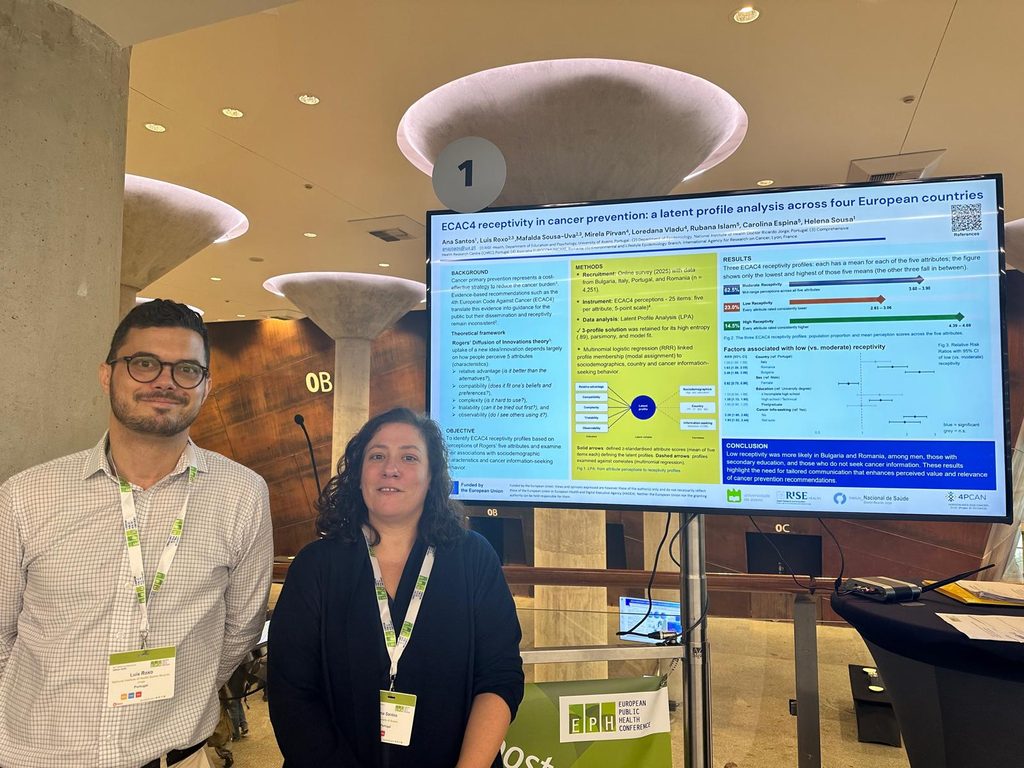
The first poster, “European Code Against Cancer receptivity: latent profile analysis across four European countries”, led by Ana João Santos, examined how adults from Portugal, Italy, Romania, and Bulgaria perceive the recommendations of the 4th European Code Against Cancer (ECAC4). Using Rogers’ Diffusion of Innovations framework, the study analysed factors as perceived usefulness, compatibility with personal values, complexity, trialability, and observability, and identify distinct receptivity profiles to ECAC recommendations.
The findings reinforce the importance of tailoring cancer prevention messages to different national and social contexts and developing strategies capable of engaging populations who are less connected to health information.
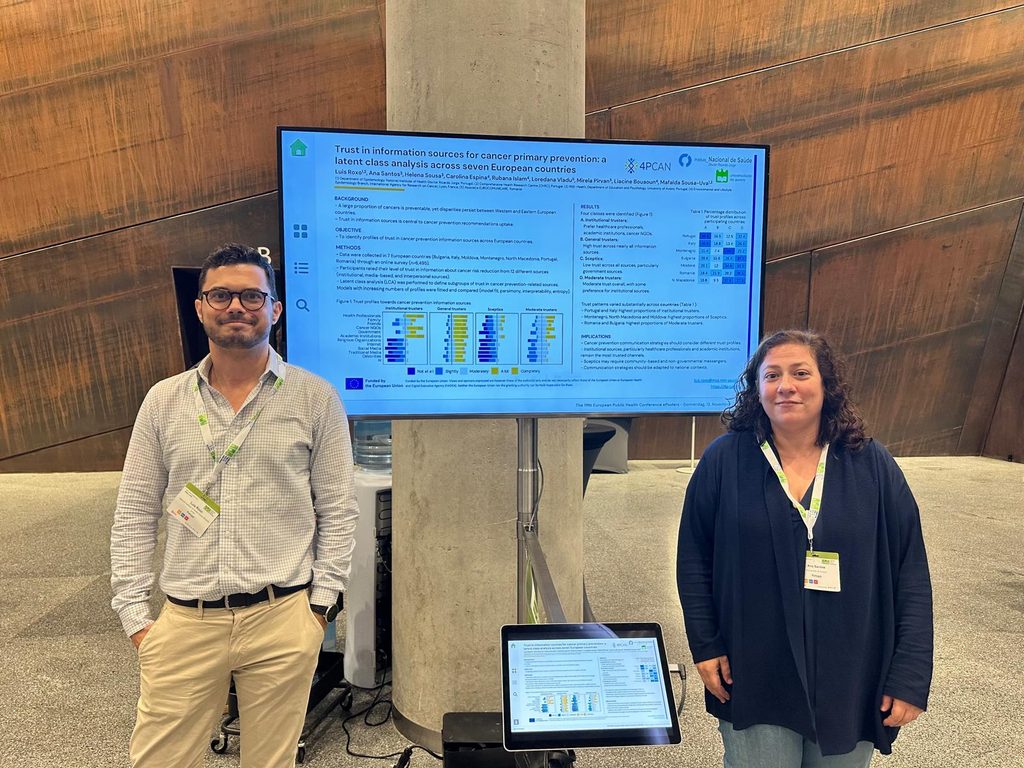
The second poster, “Trust in information sources for cancer primary prevention: a latent class analysis across seven European countries”, led by Luis Filipe Roxo (INSA), explored patterns of trust in cancer prevention information sources among 6,495 participants from seven European countries. Using latent class analysis, researchers identified four distinct profiles of trust in cancer primary prevention information, with varying degrees of trust regarding healthcare professionals, academic institutions, and cancer NGOs. Results also revealed important differences between countries, highlighting the need for communication approaches that are adapted to national contexts and audience characteristics.
Although these are preliminary findings from ongoing scientific publications, both studies contribute directly to the objectives of 4P-CAN by improving understanding of cancer prevention attitudes, beliefs, and behaviours across partner countries. The evidence generated will support the development of more effective and targeted communication campaigns and help inform future recommendations for the 5th edition of the European Code Against Cancer (ECAC).
By identifying differences in trust and receptivity across populations, WP4 is helping ensure that cancer prevention messages are not only evidence-based, but also relevant, accessible, and impactful for diverse audiences across Europe.